Changing the Paradigm for analyzing illicit supply and Drug trafficking in France

Sahel

Sahel

Convoys under fire

Convoys under fire

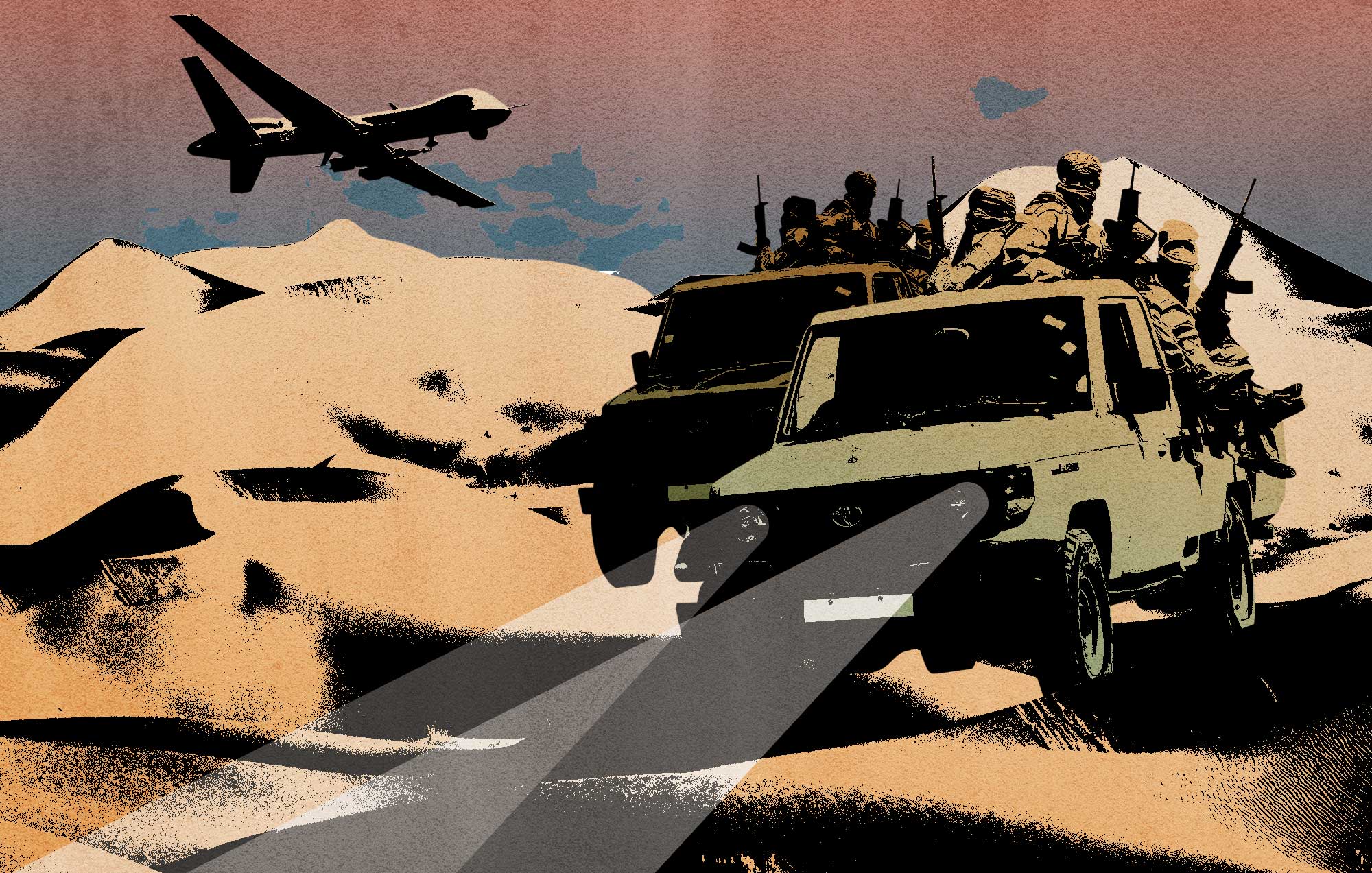
Amid the shifting battle lines of northern Mali, drug convoys push across the open desert under cover of night, their headlights slicing through waves of sand as they navigate increasingly perilous terrain. What were once routine crossings have become high-risk runs, with traffickers forced onto remote bypass routes to avoid towns now contested by armed groups. In this vast, exposed landscape, trucks become vulnerable silhouettes against the dunes - easy targets for the drone and airstrikes that have already hit vehicles in places like Lerneb and Anefis, turning each journey into a gamble between profit and survival.

Crossroads of Africa

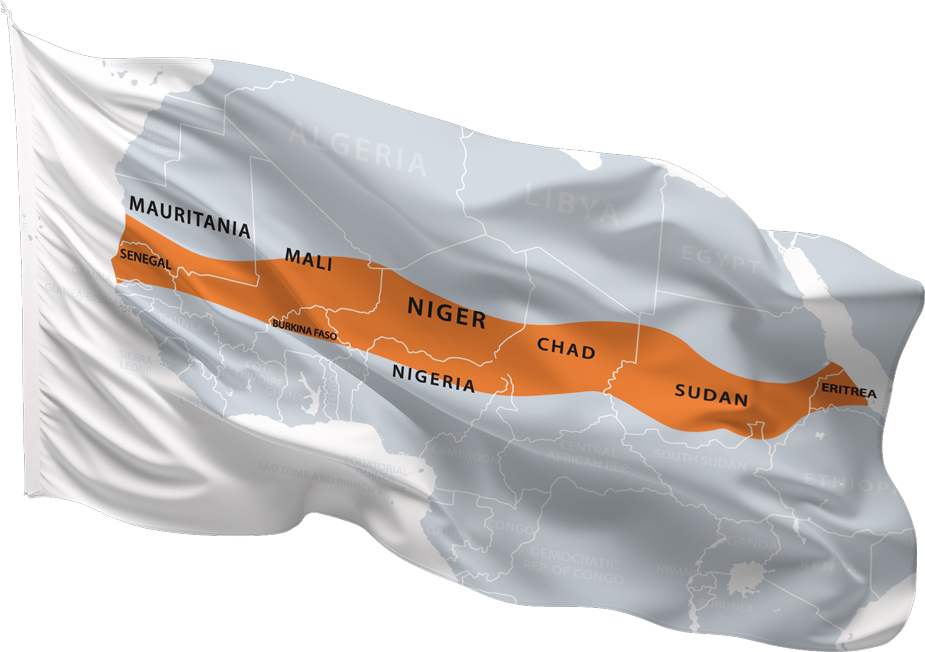
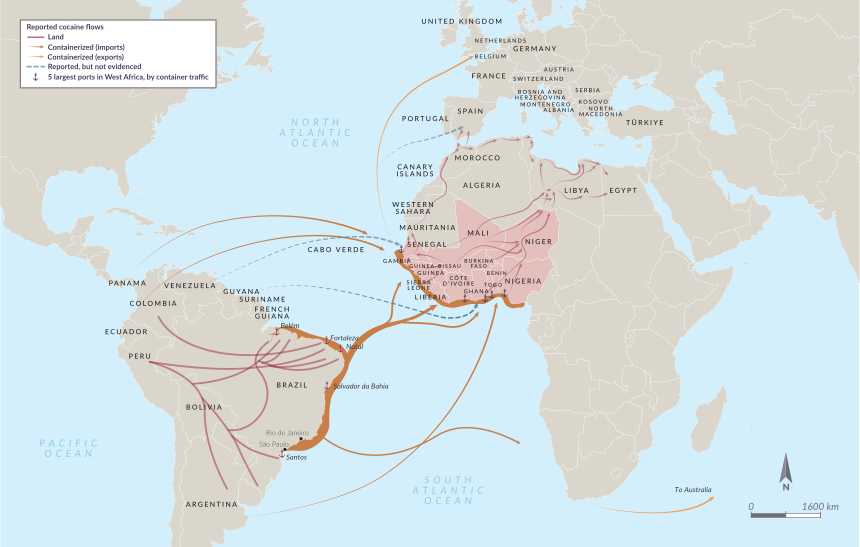
The Sahel forms the connective tissue of a vast transcontinental drug economy, linking Morocco's booming hashish production to the cocaine flows entering West Africa through Gulf of Guinea ports, and onward to Libya - a crucial gateway to North African and European markets. Hashish moves eastward from Morocco through Mauritania and Mali, while cocaine routed via coastal states like Togo or Benin pushes north through Mali or Niger. These currents converge across the Sahel's desert corridors before funnelling into Libya, where established smuggling infrastructures move shipments toward Mediterranean departure points. In this way, the Sahel acts as both bridge and buffer, knitting together three major trafficking spheres into a single, adaptive system.
Drugs + instability

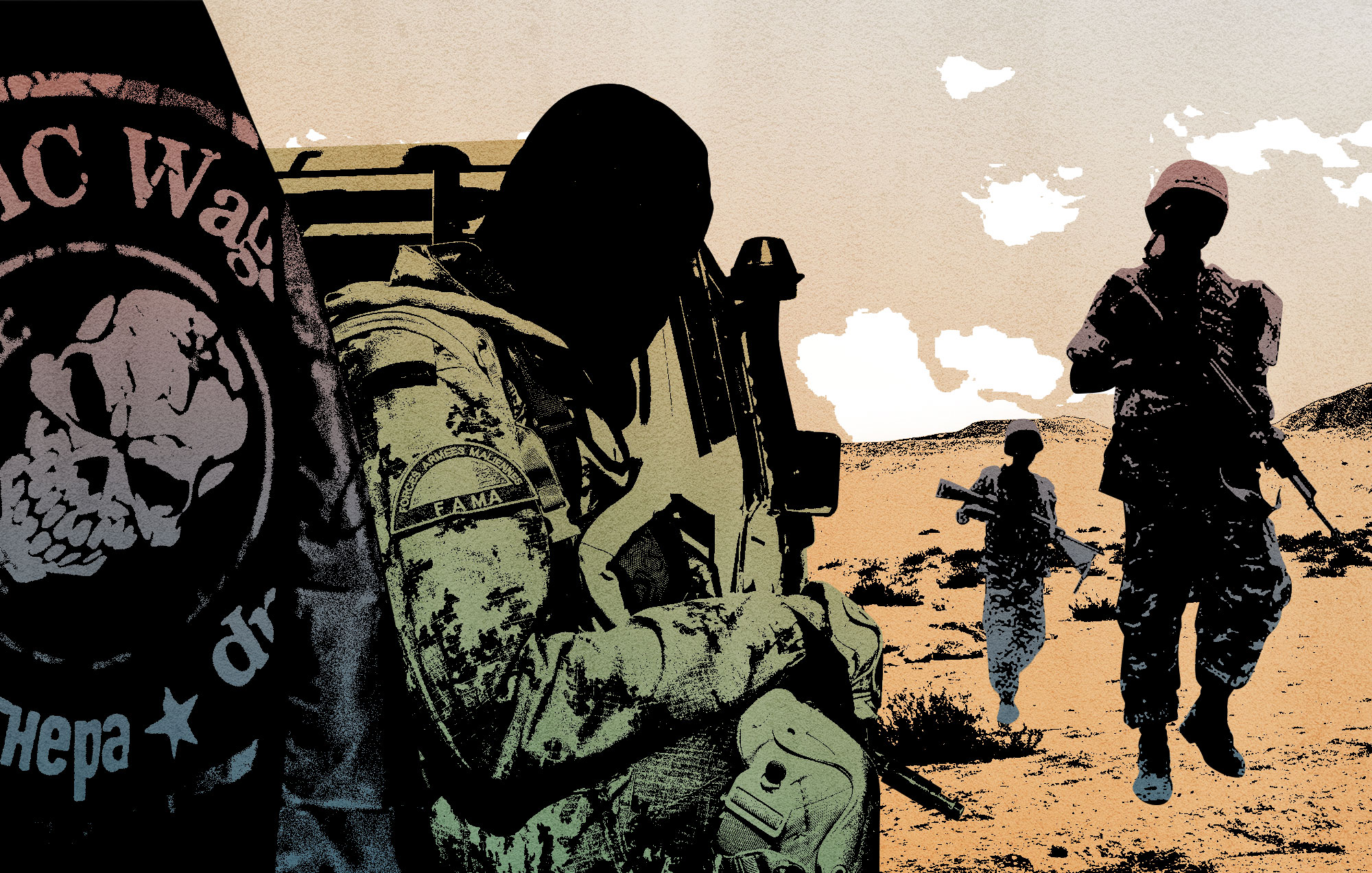
In the Sahel, recent political upheavals in Niger and Mali have sharply reshaped the security and trafficking landscape. Niger's July 2023 coup toppled President Mohamed Bazoum and dismantled long-standing networks linking political elites to trafficking operations, creating a climate of uncertainty in which high-level traffickers lost protection and scaled down their activities. In Mali, the withdrawal of MINUSMA in 2023 triggered a rapid escalation of conflict between armed groups and the Malian army backed by Wagner forces, culminating in the takeover of key northern towns such as Kidal. These shifts destabilised traditional corridors, intensified violence, and forced trafficking networks to reroute or adapt to new territorial realities - upending the delicate balance that had long enabled drug flows to move with relative predictability through the region.

Mali convulsions

Mali convulsions

The joint advance of FAMa and Wagner forces into northern Mali has transformed Kidal into one of the central flashpoints of the conflict. After the withdrawal of MINUSMA, clashes between the Malian army, Wagner, and armed groups escalated sharply, culminating in the capture of Kidal - a symbolic and strategic stronghold long controlled by the CSP. The offensive triggered intense fighting and widespread atrocities attributed to FAMa and Wagner, pushing more than 30,000 people to flee, with over 70% of the town's population displaced to rural areas or into Algeria. This upheaval not only reshaped territorial control but also disrupted trafficking networks embedded in the region, forcing them to scatter, hide, or reroute in response to the shifting front lines and the heightened risk of violence.

Niger upheaval

Niger upheaval

In Niger, the boundary between political power and criminal enterprise has long been porous, with trafficking networks benefiting from protection and facilitation by figures embedded at the highest levels of the state. Under the previous regime, these relationships enabled drug convoys to move with relative impunity through northern corridors. The 2023 coup abruptly disrupted this ecosystem: political patrons fell, trust in new authorities evaporated, and high-level traffickers were forced to lower their profile or pause operations. The arrest of local officials involved in large cocaine shipments underscores how deeply intertwined governance and trafficking had become - and how the sudden rupture of these alliances has reshaped the criminal landscape.

Malian networks

As conflict reshaped control of northern Mali, traffickers lost access to critical hubs such as Anefis and Tabankort - once central nodes for storing and coordinating hashish convoys. With these areas now contested or too exposed to drone strikes, networks shifted their logistics deeper into remote terrain, relocating storage to Inafarak, far from active fighting. Some flows have also been pushed northward toward Taoudenni, forcing convoys across the harsh Tanezrouft desert, where dunes and vast isolation make travel slower and riskier. Despite the punishing conditions, these routes offer safer passage by avoiding the conflict-ridden Kidal region, underscoring traffickers' ability to adapt even under extreme pressure.

Nigerien networks

Nigerien networks

The 214-kilogram cocaine seizure discovered in the car of a Nigerien mayor exposed just how deeply trafficking networks had penetrated local governance structures. The shipment, which had reportedly crossed from Mali and was destined for Libya and ultimately Europe, revealed a level of political protection that allowed high-value consignments to move through Niger's northern corridors with confidence. Its interception following the 2023 coup highlighted how the political realignments and loss of elite patronage have begun to expose long-hidden networks, forcing traffickers to operate with greater caution as old alliances collapse and new uncertainties take hold.

Old vs. New Mali corridors

Long-standing trafficking corridors running from Araouane through Anefis and Aguelhok toward Niger and Libya have been heavily disrupted by shifting territorial control and intensified violence, pushing networks to reconfigure their movements across the Sahel. As Anefis and surrounding areas became high-risk due to clashes and drone strikes, some traffickers redirected flows far north through Taoudenni, crossing into Algeria at Bordj Badji Mokhtar before continuing east toward Libya - a longer, harsher route that traverses the unforgiving Tanezrouft desert but avoids conflict hotspots. Others have opted for wide detours, either swinging south via Kayes and Segou or shifting west through Tindouf to enter Algeria. These adaptations illustrate how the region's trafficking architecture bends but rarely breaks, continually recalibrating to maintain access to key North African gateways.

Rise of air & maritime routes

Alongside the reconfiguration of land corridors, traffickers have increasingly turned to air and maritime routes to move high-value consignments out of the Sahel. From Bamako and Niamey, cocaine is now flown to Europe via couriers on commercial flights as well as private aircraft that bypass routine scrutiny. At the same time, maritime flows have expanded along the Atlantic, with hashish and cocaine departing Morocco and transiting West African coastal hubs before heading toward Europe - or even looping westward toward South America. These alternative routes offer resilience amid conflict on land, enabling networks to diversify their logistics while preserving access to major consumer markets.

Niger's decline + Resilience in chaos

As conflict intensified around Kidal and key nodes like Anefis and Tabankort were lost, the volume of drug convoys moving through the region dropped sharply. With routes disrupted, risks rising, and traffickers diverting shipments through Algeria, the far north, or southern detours, fewer convoys now pass through eastern Kidal toward Niger. This contraction has directly affected the intermediaries - drivers, guides, fixers - whose livelihoods depend on those flows, leaving many without business as networks relocate or suspend their usual movements.

In the Sahel, conflict doesn't halt trafficking - it forces it to evolve. Shifting front lines, political upheaval, and disrupted alliances have pushed networks to abandon old hubs, carve out new corridors, and diversify into air and maritime routes. While violence can temporarily suppress flows or sideline intermediaries, the adaptability of traffickers ensures that the trade persists, reconfiguring itself around instability rather than being extinguished by it.

These digital tools have been developed with contributions from the GI-TOC Observatory of Violence and Resilience in Haiti (HT-Obs), the GI-TOC Observatory of Organized Crime in Europe (EUR-Obs), and the Observatory of Illicit Economies in the Amazon Basin (AMA-Obs). They are part of our broader analytical work on transatlantic drug trafficking and aim to share key research findings with a wider audience of stakeholders, including policymakers, law enforcement officials and civil society. This project has been funded, in whole or in part, by MILDECA, the French government's Interministerial Mission for Combating Drugs and Addictive Behaviours, under the authority of the Prime Minister.

Global InitiativeGouvernement Francais et MILDECA